Many organisations want to let employees put questions to their policies, but an AI that answers incorrectly is worse than no AI at all. Here we go through what AI search in governance documents is, why accuracy is decisive and how you can make sure the answers are correct.
What is AI search in governance documents?
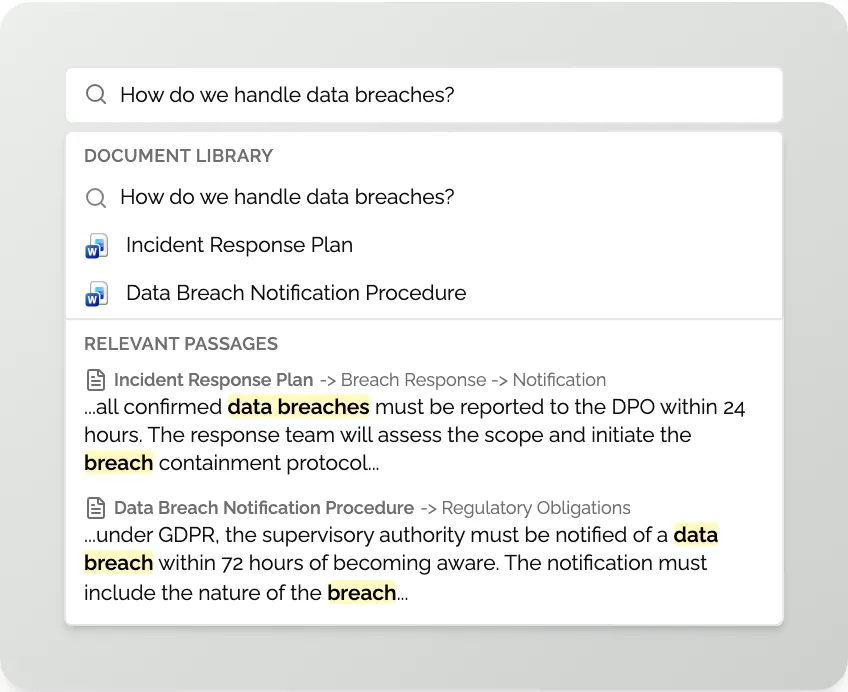
AI search in governance documents means that employees can ask questions in plain language, for example "How do I file a travel expense claim?" or "What do I do if I suspect money laundering?", and get an answer based on the organisation's own policies and procedures. Instead of searching through folders and PDF files, they get the answer directly, with a reference to the source.
The difference from a general chatbot is that the AI search only retrieves information from the company's own document base. It does not guess based on what is on the internet.
Why is accuracy so important?
In regulated industries such as banking, finance and insurance, the questions are often about regulatory compliance. An incorrect answer about money laundering, internal control or the code of conduct can lead to actual deviations and sanctions.
That is why it is not good enough for an AI search to be right "most of the time". Several organisations that have tested general chatbots have become sceptical for exactly that reason. The requirement is that the answers are traceable, correct and based on current documents.
How AI search in governance documents works in practice
A reliable solution builds on a few principles:
- A delimited source: The AI only searches your approved governance documents, not open sources.
- Source references: Every answer shows which document and which section it is based on, so that the employee can check.
- Current versions: Only valid, adopted versions are used, so that old policies do not turn up.
- Clear boundaries: If the answer is not in the documents, the AI should say so instead of guessing.
How do you ensure the quality of the AI search?
Start with order in the documentation itself. AI search is only as good as the material behind it. Gather policies, guidelines and procedures in one place, with clear version control and an owner for every document.
Then test the solution with real questions from the business. Let the compliance function review the answers before you roll it out more widely. Some organisations also choose to add laws and regulations as reference material, which supports employees without mixing up external rules with the organisation's own governance documents.
What about security and data protection?
Questions about IT security almost always come up. Set requirements for how data is stored, who has access, how permissions are controlled and how the supplier handles information security. Organisations with high demands on procedures should ask for documentation and references from other customers in regulated industries.
How can AI make policies more widely used?
A common problem is that policies are long and seldom read. AI can summarise a policy so that more people take it in, answer questions in the moment and connect the policy to training, for example quizzes and e-learning. The governance documents then become living support in everyday work instead of something that sits in a folder for the sake of the audit.
Common mistakes to avoid
- Using a general chatbot for compliance questions.
- Leaving old document versions in the search base.
- Not involving compliance and IT early in the choice.
Would you like to see how AI search works in North House? Get in touch at sales@northhouse.se!