The supervisory authority gets in touch and wants to see your current conflicts of interest policy, and how it has been communicated to employees. The latest version is in someone's email, the previous one on the intranet, and nobody can say who has read which.
It is a common situation. In this post we go through what governance document management is, why it matters and how to get started.
What is governance document management?
Governance document management is the way of working for creating, adopting, distributing, following up and archiving the organisation's governance documents: policies, guidelines, instructions and procedures.
The different document types serve different functions. The policy states what applies and why, the guideline how the organisation should work, and the instruction or process what happens in practice. When that structure is clear, it also becomes easier to keep track of versions and responsibilities. If you want to go deeper into how the levels fit together, read From a document jungle to a clear structure: How governance documents fit together.
The goal is twofold. Employees should always find the right document in the right version. Management and the board should be able to show that the documents are known and followed.
Without a clear process, the documents end up in email attachments, shared folders and old intranets. Then the question "what applies?" becomes hard to answer, for employees and for supervisors.
Why is governance document management important?
The requirements for documented governance are increasing, both from the EU and from Swedish authorities. Regulations such as DORA for the financial sector and NIS2 for, among others, the energy sector require clear policies that are kept up to date.
For banks, energy companies and other regulated businesses, it is common for supervisors to request the documents that are adopted right now. They also want to see that the documents are updated and communicated.
Three concrete risks when governance document management falls short:
- The wrong version is followed. Employees work according to a policy that no longer applies.
- You cannot show who has read what. An adopted document without read confirmations is hard to stand behind.
- Supervisory reviews take unnecessary time. Material has to be dug out manually every time someone asks.
How does version control of governance documents work?
Good version control means that there is always a clear current version. It should be possible to see what has changed between versions, and who adopted the document and when. Employees should never have to guess or search through emails.
Practical tips:
- Have a single source of truth for all governance documents.
- Mark clearly what has changed compared with the previous version.
- Assign a responsible owner and a date for the next review to every document.
What do you do with outdated documents?
Archive them, do not delete them. You may need to show what applied at a certain point in time, for example when a decision was made or an incident occurred.
An archived document disappears from what employees see, but remains and can be retrieved. That gives order for the employees and traceability for the organisation.
How do you get employees to actually read the governance documents?
An adopted document is not the same as a read document. This is where many organisations fall behind, and this is where supervisors often ask.
Three things that make a difference:
- Read confirmations. You see who has read new or updated information, and can remind those who have not.
- Short summaries. An accessible summary of a long policy means that more people actually read it.
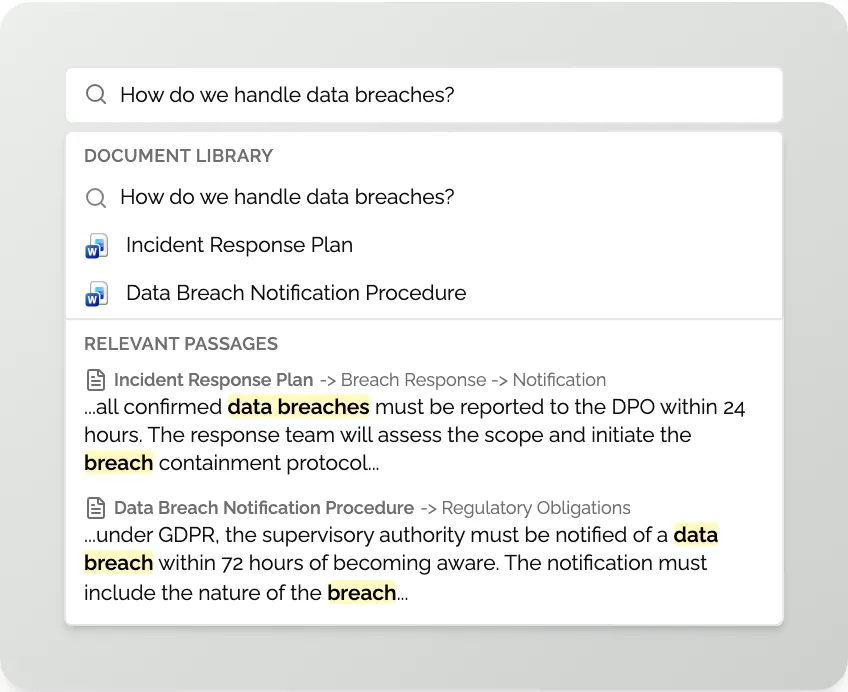
- Searchable documents. Employees can ask a question and get an answer from the organisation's own governance documents, instead of searching through document libraries.
Why does governance document management become more important with AI?
When AI assistants answer employees' questions based on your governance documents, the quality of the documents becomes decisive. An outdated version in the wrong folder no longer gives an incorrect answer to one person. It can give the same incorrect answer to everyone who asks.
This means that version control, archiving and clear ownership are not just a matter of order. They are a prerequisite for AI to be used safely. Read more in AI search in governance documents: how to get answers you can trust.
How to get started with better governance document management
- Map. Which governance documents do you have, and where are they today?
- Gather. Put them in one place, or connect your current document system, for example SharePoint, to a solution for governance document management.
- Assign responsibility. Decide on owners, who adopts each document and when it is to be reviewed.
- Introduce routines. Read confirmations for new versions and a clear archiving routine for what no longer applies.
- Follow up. Go through regularly what has been read, is overdue or needs updating, so that you are always ready for a supervisory review.
Summary
Good governance document management comes down to three things: that everyone knows what applies, that you can show that it is known, and that outdated documents are archived in the right way. It reduces risk, saves time and makes supervisory reviews calmer. And when AI starts answering based on your documents, it becomes even more important.
Would you like to see how North House can help you get your governance documents in order? Book a demo here.