
From a document jungle to a clear structure: How governance documents fit together
Governance begins with language and structure
At its core, governance is about how an organisation is directed. That may sound rigid, but it is simply a way to ensure the right things are done in the right way, by the right people, at the right time.
To achieve that, we need a shared understanding. And that starts with speaking the same language.
So what exactly is a governance document?
What is a governance document?
A governance document is a formal document describing what, how or why something should be done within an organisation. It provides guidance, allocates responsibility and creates confidence, particularly in regulated sectors such as finance, law or healthcare, where risks are high and margins for error are small.
But governance documents come in different forms and at different levels. Confusing them, or lacking a clear structure, is one of the most common problems we see in organisations that are growing or changing.
A real-world example: The policy nobody reads
A medium-sized technology company had an information security policy formally approved by the board. It was published on the intranet, but few had read it. Even fewer understood what they were actually supposed to do differently.
Meanwhile, IT had detailed instructions, the communications team had its own guidelines for passwords in external campaigns, and HR was trying to create onboarding material from scratch.
Everyone meant well. But without structure, the overall picture fell apart.
Document jungle or governance document structure?
It is easy to end up in a document jungle:
-
Policies are written by different teams without a shared understanding.
-
Version control is handled manually, or not at all.
-
Instructions survive as attachments in old email threads.
The solution is to build a clear document hierarchy. This means each type of document has its own place, purpose and audience.
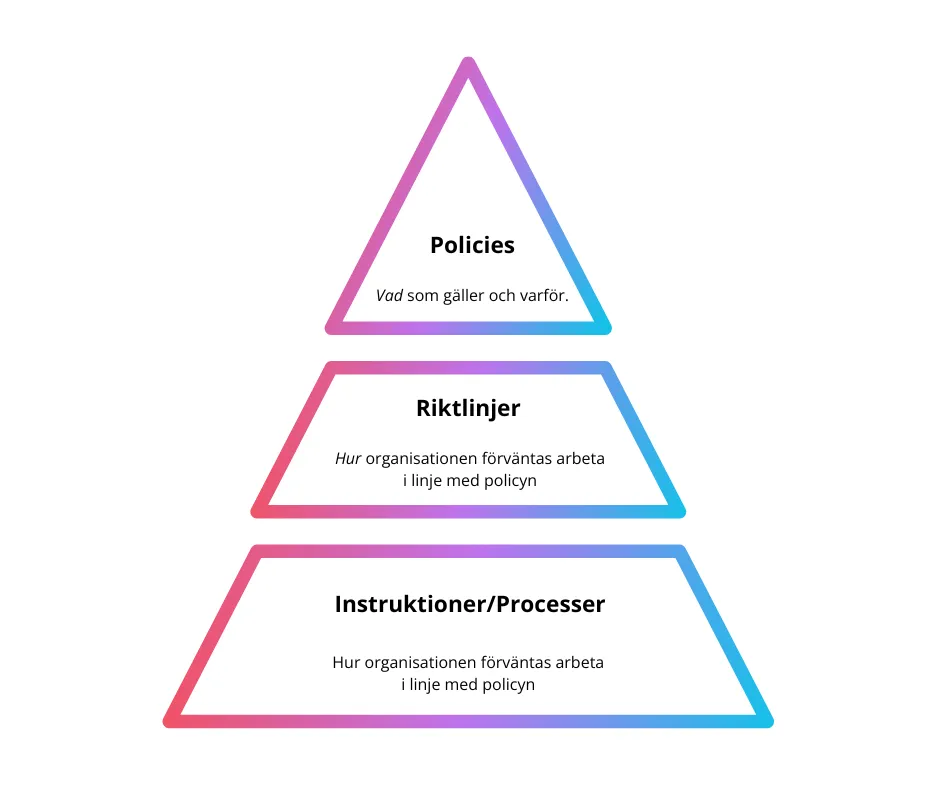
Imagine a pyramid. The higher you go, the more principle-based it becomes. The further down, the more concrete and detailed.
What a governance document hierarchy looks like
1. Policies and governing documents
The top of the pyramid. Here you state what applies and why. These are overarching principles, often based on external requirements such as legislation, industry standards or internal values. They are formally adopted by the board.
Example:
Information Security Policy, Anti-Corruption Policy, Code of Conduct
Typical wording:
“The company shall ensure confidentiality, integrity and availability in all handling of customer data.”
Audience: Everyone in the organisation
Level of detail: Low — principle-based
2. Guidelines
The next level. Here you describe how the organisation is expected to work in line with the policy. It is still general, but more practical. Adopted by the responsible manager or function.
Example:
Access Management Guidelines, Remote Working Guidelines
Typical wording:
“Employees working remotely must use multi-factor authentication and up-to-date antivirus software.”
Audience: Managers and responsible functions
Level of detail: Medium — adapted to the situation
3. Instructions/Processes
Here you show what happens when, and between whom. This is about workflows and the allocation of responsibility.
Example:
Incident Management Process, Onboarding Process, Access Management
Typical wording:
“When an incident is identified, it must be reported to the information security manager within 2 hours.”
Audience: Operational staff
Level of detail: High — sequence-based
Why does the hierarchy matter?
When everything is called a “policy”, or one document tries to do everything at once, confusion follows.
Benefits of a clear structure:
-
You know who is responsible for what.
-
You can update details without changing principles.
-
You make it easier for others to understand and comply.
-
You are well prepared for audits and due diligence processes.
How it fits together: An example
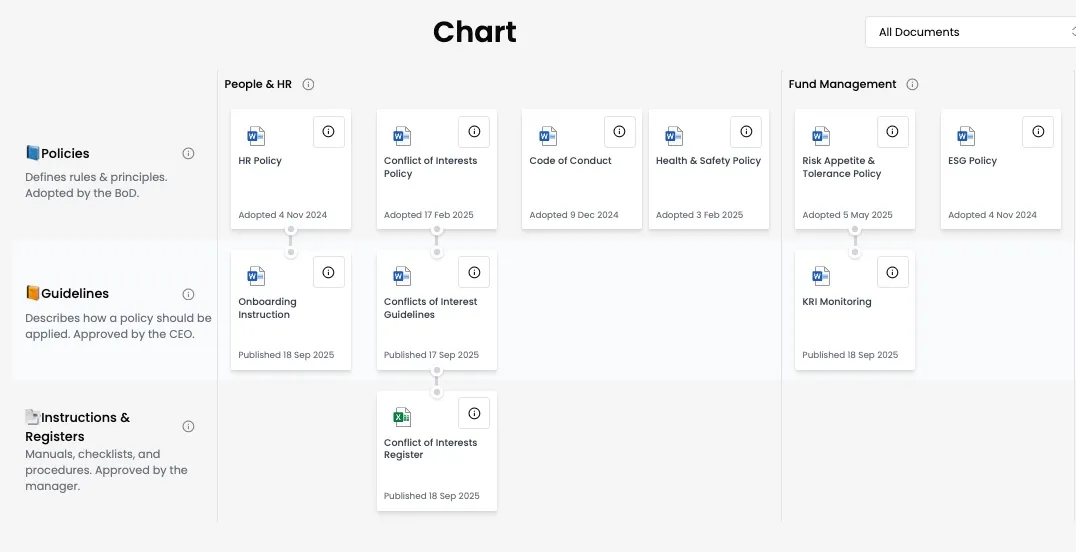
Suppose you have a Cybersecurity Policy. You should also have:
-
Guidelines describing how different teams should work with passwords, authentication and training.
-
Instructions/Processes showing how incidents are handled, who is alerted and how recovery takes place.
When an auditor or supervisory authority asks:
“How do you ensure information security?”
...you can show them:
“This is our policy. Here are the guidelines. Here is the process flow. And here are the instructions our IT staff follow.”
That is governance that works in practice, as well as on paper.
Common mistakes (and how to avoid them)
“We have a policy, but nobody follows it.”
Often a sign that the policy is too vague or is not linked to concrete guidelines or instructions.
“We cannot find the right version.”
Often caused by the absence of a digital document management system.
“Different teams have created their own documents saying different things.”
This happens when there is no shared structure or central responsibility.
How to avoid it:
-
Agree on a shared hierarchy
-
Create document templates for each level
-
Create workflow templates for each level
-
Appoint document owners
-
Use a digital tool with version control
-
Schedule regular reviews
Governance in everyday work
Governance does not belong solely to the legal team or management. It affects how you communicate internally, manage risks, build culture and ultimately deliver value to customers.
When documents are understood, up to date and clear, they are more likely to be used. That is where governance makes a difference.



Get a demo
See how North House can enhance your organization's governance. Schedule a demo today!
Customer Support
North House provides governance solutions that adapt to your organization's evolving needs.