
Version control for governance documents: how to make sure everyone uses the right version
Which version of the policy actually applies? If that question keeps coming up in your organization, you are not alone. Here we go through what version control for governance documents means, why it matters and how to do it in practice.
What is version control for governance documents?
Version control for governance documents means keeping track of every change to policies, guidelines, procedures and instructions. You should always be able to see which version is in force, who changed what, when it happened and why.
It is about more than file names like Policy_v3_final_NEW2.docx. It is about a system where it is never unclear which document applies, and where earlier versions remain as a traceable history.
Why does version control become a problem?
In many organizations, governance documents are scattered: in shared folders, on the intranet, in SharePoint and in email attachments. That leads to a few classic problems:
- Several copies in circulation. Someone saved an older version to their desktop and keeps following it.
- Unclear ownership. Nobody knows who is responsible for keeping the document up to date.
- Hard to see what changed. Employees get no clear picture of how the new version differs from the old one.
- Outdated documents linger. Without a clear archiving routine, old policies stay next to the new ones.
Why does it matter that everyone uses the right version?
For organizations with requirements for internal governance and control, a wrong version is not just a practical problem. It can become a risk. If an employee follows an outdated procedure for, say, information security or anti-money laundering, it can have consequences in an audit or a supervisory review.
Clear version control also gives you:
- Traceability: you can show what applied at a given point in time.
- Confidence for employees: they don't need to ask their manager or a colleague, but find the latest procedure right away.
- Errors are spotted sooner: when everyone sees the same current version, anything wrong or outdated stands out right away.
How do you work with version control in practice?
1. Have a single source of truth
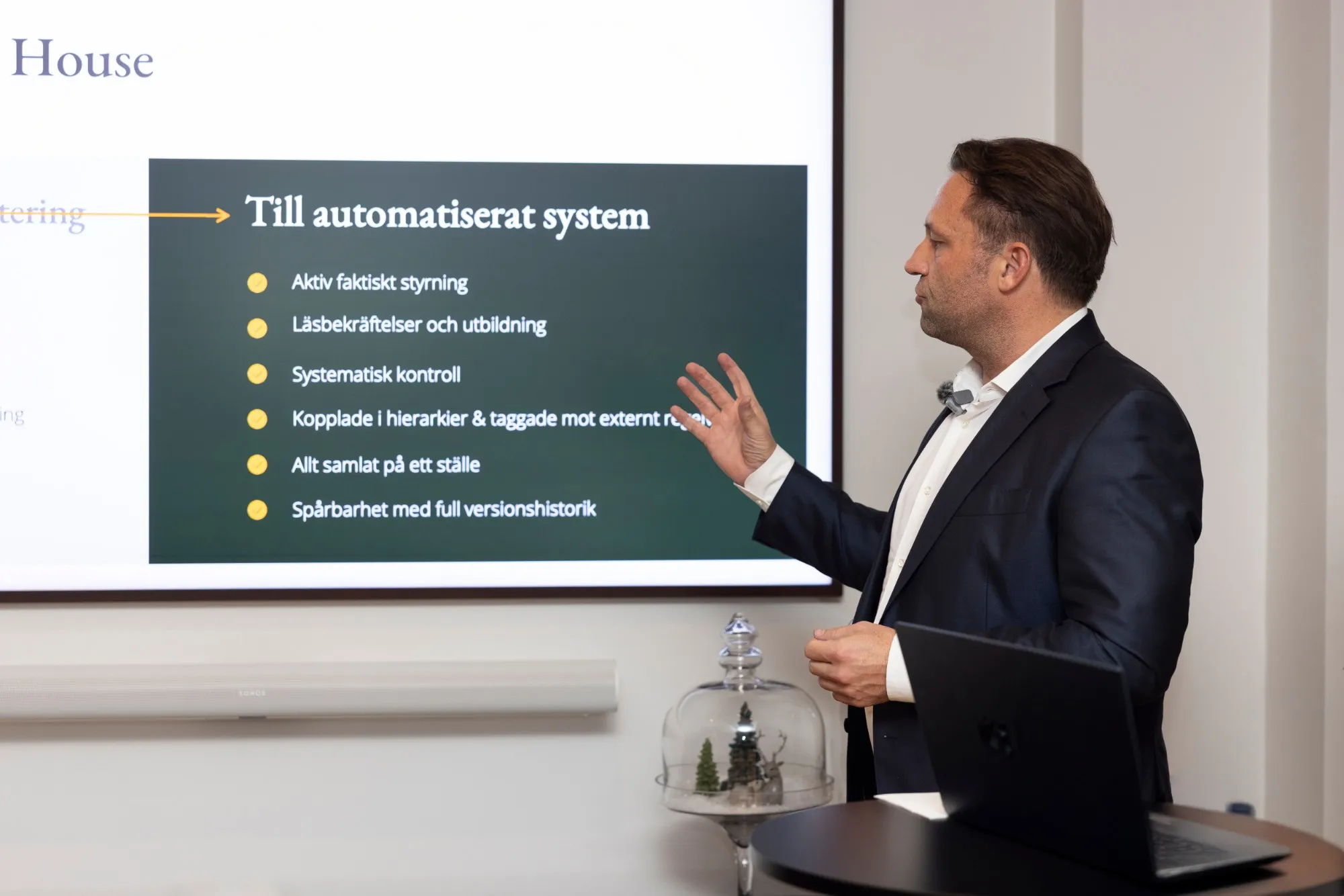
Gather your current governance documents in one place. If you already use SharePoint or another document system, a policy management system can act as the management layer on top, keeping documents up to date without manual administration.
2. Define owners and review dates
Every document needs someone responsible and a date for its next review. Updating then becomes a routine, not something done only when someone happens to remember.
3. Make changes clear
When a new version is published, readers should see what changed compared with the previous version. A short change summary and highlighted differences reduce the risk of important changes being missed.
4. Archive instead of deleting
Documents that no longer apply should not disappear, and they should not stay among the current ones either. Move them to an archive where they are searchable but clearly marked as no longer in force. That way you keep the history and avoid mix-ups. Read more in our guide on how to get versions and archives in order and be ready for supervisory review.
5. Keep working in Word, without downloading and uploading
You don't need to change how you work to get your versions in order. With North House, you keep editing your governance documents in Word, just as before. Changes are saved and updated automatically in the system, so there is no need to download files, edit them locally and upload them again. The new version replaces the old one in a controlled way, and everyone always sees the same current document.
6. Follow up that documents have been read
Version control only works once employees actually take in the changes. Use reminders and read confirmations for larger updates.
Common mistakes to avoid
- Relying on file names to mark the version.
- Letting several people edit local copies in parallel.
- Not having an archiving routine.
- Publishing changes without saying what changed.
Summary
Good version control for governance documents comes down to a single source of truth, clear ownership, visible changes, working archiving and a way of working where you can keep using Word. Employees no longer have to wonder which version applies, and you are better prepared for audits and supervisory reviews.
Sound familiar? Also read “Which version applies again?” on what scattered governance documents cost in time and risk.
Want to see how North House helps you keep track of versions, changes and archives for your governance documents? Book a demo.


Get a demo
See how North House can enhance your organization's governance. Schedule a demo today!
Customer Support
North House provides governance solutions that adapt to your organization's evolving needs.